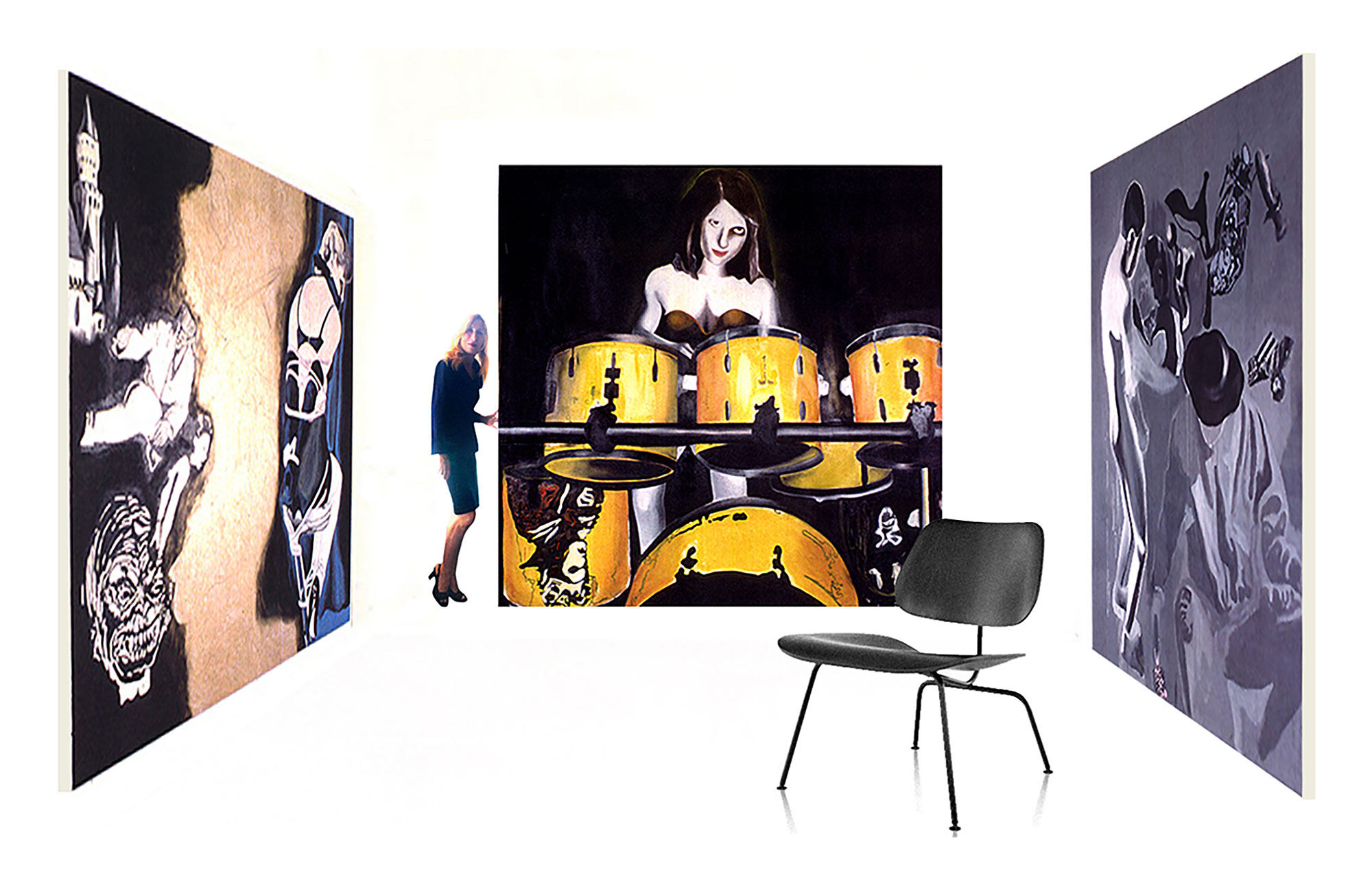
Yes, I am now controlling the narrative around my art — which I should have done decades ago. These paintings are symbolic — not literal. Jane Rubin is not an aggressive drummer or a real-life bad girl. If people paid attention to the actual paintings — rather than forcing their narcissistic fantasies about me onto my art — they would notice that in the center self-portrait, I am not actually playing the drums. I was wearing a feminine corset and posed behind an actual drum set — to represent feminine power — but I was not banging the drums. I come from a musically talented family, both sides, and we all have natural rhythm. But I am physically and hormonally feminine. (I am not a macho drummer). Facts: Jane Rubin, a biological feminine girl, was an advanced ballerina and pianist growing up in York, PA. Since the 1980s, Jane has turned down all of the supposedly great "opportunities" she was offered to hang out/party with mass-market entertainers and athletes, and she has also avoided art world party scenes. Facts: Jane Rubin always has the self-discipline of a ballerina. Jane Rubin is also a CSA Survivor. Jane avoids wild scenes and wild people. Jane does not use drugs. Jane rarely even drinks. Do not confuse Jane Rubin's art with her real life.

These larger-than-life paintings were painted by Jane in the Whitney Museum ISP, from September to May, 1989–90. The centerpiece, the symbolic self-portrait, and the symbolic gray painting, are not finished. In under nine months, Jane composed and painted these audacious, larger-than-life figurative paintings on her own (no studio assistants helping her). She also created numerous small-scale paintings, one of which is in the collection of Hal Foster, who asked to purchase it at the end of the Whitney Program.
These large-scale paintings were not published in the Whitney ISP Catalog that year, because curatorial fellows Sarah Morris and Julia Reschop (also working as studio assistants for Jeff Koons at the time) were in charge of organizing the catalog and, at the last second, the night before it was going to the printers, blocked the fold-out of her large-scale paintings that Jane had proposed as her entry in the catalog from being published. While Jane was down the hall in her studio painting — Sarah and Julia were conducting their final catalog meeting in the seminar room — and Sarah shouted about Jane's proposal: "She'll get too much attention." That was her reason for blocking it. Other artists in the program came to Jane's studio right after the meeting to let her know they thought Jane's proposal should be published, that no one had a right to block it. The next morning, Ron Clark claimed to Jane that the reason for blocking her large paintings was that it was too expensive to print a fold-out of her 3D triptych. If cost were actually the issue, then Jane should have been allowed to publish a photo of the entire installation on one page, and each of the three paintings on a separate page. Every artist was given multiple pages in the catalog. However, neither Ron, nor Sarah and Julia, offered that as an alternative solution. That morning, Jane scrambled to come up with something to have in the catalog, putting together a montage of smaller paintings and drawings. All of their excuses were BS.
They were cheating against Jane, who also happened to be the only Jewish artist in the program.
Jane Rubin was selected for the Whitney Program (without an interview, a rarity) for her talent and originality. Any curating student or staff member of the Whitney Program (with funds from the Helena Rubinstein Foundation funding them) who blocked the talent and originality of a Whitney Program Artist from being published should have been the subject of a formal complaint by Jane to the Whitney Museum of American Art, but at the time, while consistently bold and original in her art, during the 1980s — due to trauma and constant antisemitism in her childhood in York, PA — Jane did not stand up to insecure, envious mean girls, bullies, and antisemites trying to stop her, and said nothing. That would never happen again.
BTW, York, PA is also the hometown of Former Porn Star (and Anglo-Saxon Male) Jeff Koons, who was invited by the Whitney Museum to speak to children from PS 33 — on November 3, 2014, which is the birthday of Jewish-American Female Artist, Whitney Program Alum, and York, PA native Jane Rubin — who had become impoverished by years of defamation and criminal bullying of her.
The positive treatment of former porn star Jeff Koons, or David Salle, who is Jewish, worked for a porn company and created pornographic paintings, or "bad boy" artist Julian Schnabel — who is also Jewish and also a Whitney Program alumnus — versus the consistently abusive treatment of Jane Rubin — clearly indicates that misogyny (also coming from other Jewish people) has been the biggest part of the intersectional storm of misogyny, envy and antisemitism injuring Jane Rubin for decades — and also injuring Jane's family.